- Asia Sustainable Travel
- Posts
- The Business of Balance: Can Asia’s Wellness Boom Stay True to Its Soul?
The Business of Balance: Can Asia’s Wellness Boom Stay True to Its Soul?

Dear AST friend,
This week, we’re taking a closer look at one of Asia’s greatest cultural exports: wellness. From Ayurveda and Balinese healing to Japanese onsen rituals, these centuries-old practices have long drawn travelers seeking renewal. But as global demand grows, so does the question: What happens when ancient wisdom becomes overly commercialized? This week’s Feature Story explores how Asia’s wellness traditions can reclaim their authenticity — and their soul.
On Nov 2-6, we’ll be on the ground at Further East in Bali, reconnecting with APAC travel leaders. Our Co-Founder Jeremy Tran will take the stage at Open House to moderate a panel on “How to Construct and Redefine Regenerative Design.”
And on Nov 6, our Co-Founder Rhea Vitto Tabora will lead our next AST Webinar, “Biophilic Design in Hospitality: A Secret to Happier Guests & Healthier Profits.”Join us for this one-hour deep dive into how nature-inspired design can nurture wellbeing — and grow your bottom line.
If you like our content and want to support us, please share this newsletter with your friends to help us grow.
We plant a tree to welcome every new subscriber through our partnership with OneSeed.

The Business of Balance: Can Asia’s Wellness Boom Stay True to Its Soul?

Photo by Gangtey Lodge
Wellness, across Asia, is never a passing trend. Wellness practices are an inheritance, passed down through generations, woven into dawn rituals, temple offerings, forest walks, and herbal teas brewed by hand.
Long before “detox retreats” appeared on luxury itineraries, Ayurveda mapped the human body as a universe of balance, Thai massage offered preventive and rehabilitative benefits to the human body, and Zen Buddhism guided the Japanese to find serenity in simplicity.
But in the last two decades, the continent that originated many holistic healings has become the world’s largest wellness marketplace.
Asia-Pacific’s wellness tourism sector is projected to reach US $290.4 billion by 2030 — a surge driven by rising incomes, digital fatigue, and the modern epidemic of burnout.
The paradox is stark: while wellness has never been more in demand, it is also facing the greatest risk of losing its essence.

Photo by Bhutan Spirit Sanctuary.
The Industry’s Spiritual Paradox
Behind every incense trail and Sanskrit chant lies a question: Can a wellness practice built on stillness survive in a market built on acceleration?
Across the region, sacred practices are being compressed, staged, and sold.
In Bali, the sacred Melukat purification ceremony — once performed privately under priestly guidance — is now scheduled daily for visitors, complete with flower baths and cameras, often detached from their original intent.
In Thailand, temple meditations are sensationalized as mindfulness bootcamps, often stripped of Buddhist context as parodied in the popular show The White Lotus season 3.
To its credit, this commercialization has democratized access and provided livelihoods to local wellness providers. But it has also blurred the line between sacred and staged, turning prayers into photo backdrops.
The bottom line: uncontrolled growth risks corroding not only spiritual meaning but long-term market value.
When authenticity becomes spectacle, the industry loses what makes Asia’s wellness narrative unique: its depth and intentional approach.
Growth vs. Guardianship
“Asia has always understood that true wellness comes from balance — not only of body and mind, but also of our connection with nature and community,” says Mark Wong, Senior Vice President for Asia Pacific at Small Luxury Hotels of the World (SLH). The organization launched its Wellbeing Collection in August.
Yet, balance is precisely what’s hardest to maintain in a booming market.
Across the continent, the line between spiritual legacy and commercial reinvention shifts with every destination.
Each faces the same dilemma: how to stay rooted while making it accessible to the world.
Case Study — Bhutan: Where Wellness Is Lived, Not Sold
This small Himalayan kingdom — guided by the principle of Gross National Happiness — offers a living model of spiritually-led wellbeing, where connection outweighs consumption.
At Bhutan Spirit Sanctuary, every stay begins with silence and intention. “We are not a hotel,” says Anouk Cleven, Director of Sales and Marketing. “We are a sanctuary.”
As the first and still only wellness-inclusive property in Bhutan, wellness is built into daily life. Guests consult with in-house doctors trained in Traditional Bhutanese Medicine, a fully herbal practice that integrates body, diet, and spirit.
At Gangtey Lodge Bhutan, Founder Khin “Omar” Win draws a subtle but powerful distinction: “Wellness is the action,” she explains. “Wellbeing is the outcome.”
Gangtey Lodge Bhutan offers no prepackaged programs, no strict itineraries. Instead, it fosters connection — with its 61-person team, the surrounding valley, and the nearby Gangteng Shedra, a monastic college where guests can meditate with senior lamas.
→ Read more about how these two brands demonstrate a rare truth in modern hospitality: that wellness succeeds when it serves, not sells.

Photo by Gangtey Lodge
Case Study — The Philippines: Innovative Wellness Comeback Rooted in Heritage
In the Philippines, wellness is undergoing a quiet renaissance — not by intimidating global trends, but by carving its own path.
At the heart of this movement is Catherine Brillantes-Turvill, Founder of Nurture Wellness Village in Tagaytay and President of the Wellness Tourism Association of the Philippines (WeTAP).
Under her leadership, WeTAP is spearheading the Filipino Brand of Wellness (FBW) — a nationwide effort to define what authentic Filipino healing looks like in the twenty-first century.
Rooted in Hilot, a pre-colonial practice that blends massage, prayer, and plant-based remedies, FBW reframes wellness as a sensory and spiritual dialogue with heritage. “Hilot goes beyond touch,” says Brillantes-Turvill. “It’s healing through the five senses — smell, taste, sight, hearing, and touch.”
Brillantes-Turvill also warns that simplification can extract meaning from practice. “True health is inclusive when tradition isn’t overtaken by consumerism,” she says.
“By returning to our roots — planting herbs in our backyards and celebrating what’s ours — wellness becomes a birthright, not a brand.”
Pathways Forward: From Experience to Stewardship
If the last couple of decades were about experiencing wellness, the next must be about stewarding it.
To remain credible, Asia’s wellness businesses must evolve from providers of retreats to protectors of the traditions and ecosystems that sustain them.
Drawing on emerging academic and hospitality research, five imperatives stand out:
Co-create, not appropriate.
Certify and trace.
Measure what matters.
Educate through experience.
Regenerate the source.
As Mark Wong notes, “Our role is to amplify the small stories of wellbeing, and to allow our guests to connect with mind, body and soul.”
Suppose Asia can preserve the soul of its healing traditions while guiding them into the modern world. In that case, its greatest export will not be wellness experiences — but a living philosophy of balance.

Join AST Webinar on November 6
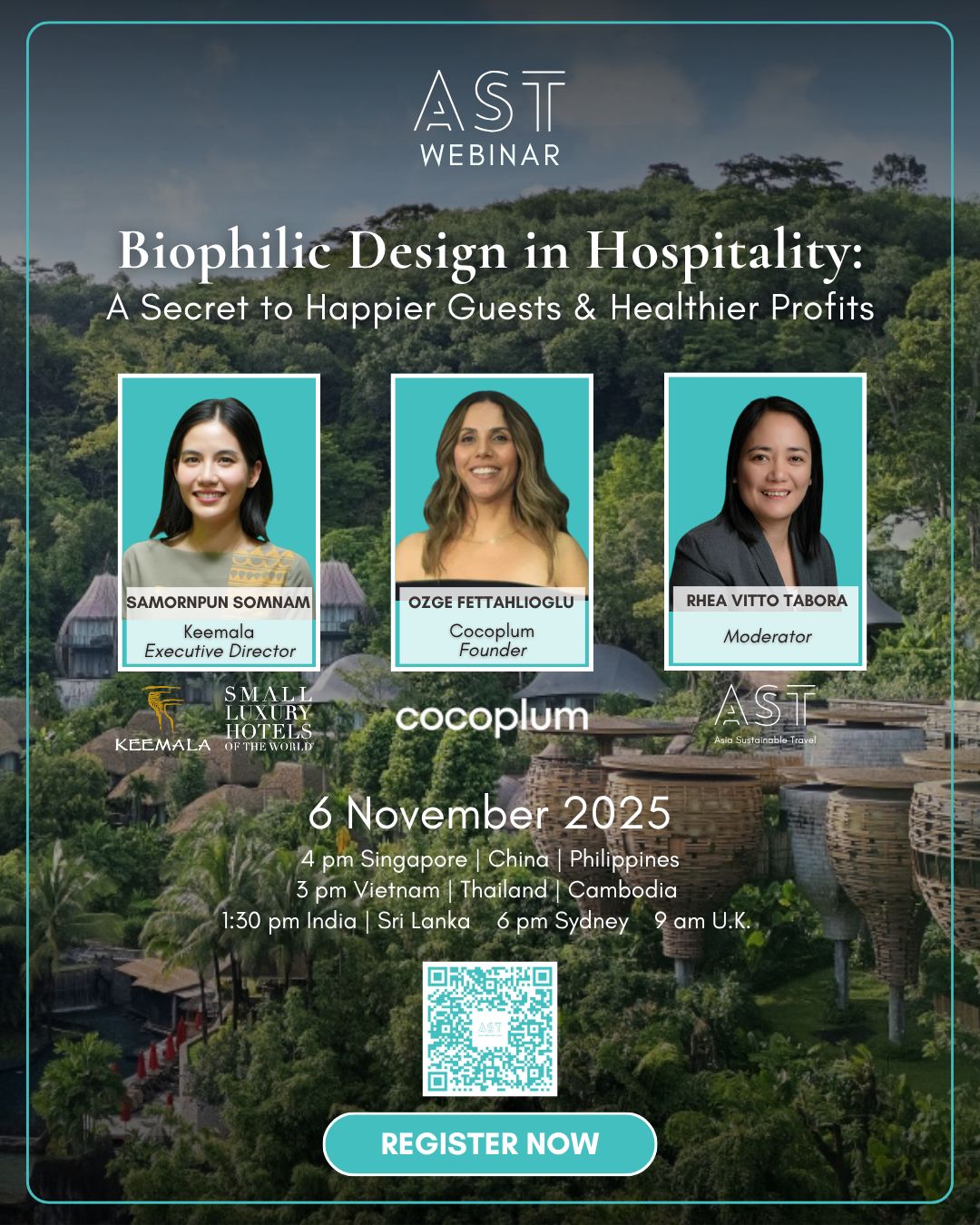
It’s free to attend the live webinar.
If you’re an AST Trailblazer, you’ll have access to the webinar recording along with the ready-to-use toolkit afterward.
Meet us at Further East

Share, Connect, and Lead on AST Webinars in 2026

We don’t need and want to create more noise in 2026.
We need solution-led, result-focused conversations that offer actionable insights to move things forward. Our webinar lineup does exactly that.
If you’re a mission-driven travel professional with tangible case studies in driving positive impacts, AST Webinar is the stage for you.
Share your hard-won lessons. Our audience wants to learn about what works.
Over the first six months of 2026, we’ll unpack pressing topics facing our industry:
→ Is Triple Win Possible? Guests Return, Communities Prosper, Nature Thrives
→ Own the Guest, Own the Revenue: Strategies for Direct Bookings
→ How to Build Next-Gen Leaders to Shape Tomorrow’s Success
→ Humans vs. AI: Are Travel Advisors Still Relevant?
→ Decoding the Carbon Funnel: From Measurement to Meaningful Action
Applications are reviewed on a rolling basis. Sessions fill up fast, often three months in advance.
📩 How to apply?
Email [email protected]
Indicate which topic you are interested in speaking about.
In 2 to 3 sentences, tell us what makes you an expert on the said topic.

 |  |
 |  |


This newsletter may contain affiliate links. If you click on one and make a purchase, we may earn a commission at no additional cost to you. Our recommendations are based on thorough research and personal experience, and we only promote products and services we genuinely believe in. Thank you for supporting our work.